


Blog
Six Rules for Assembling the Perfect Cheese Platter

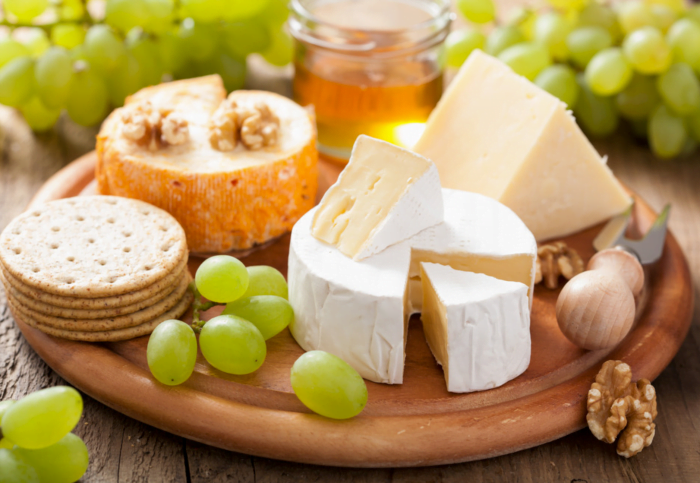
A cheese plate is something that many French people go crazy about. They serve cheese platters as a full meal, as an appetizer with wine, and even as a dessert. It all depends on how the plate is served and what products it contains.
In Russia, cheese culture is just beginning to develop, but you can already find a corresponding line on the menu in many restaurants. The only difference will be the assortment of cheeses, which in France, of course, is richer.
You don't have to go to a restaurant to enjoy this dish. You can assemble a plate at home, choosing the cheeses and products that you like. Follow our tips and rules to replicate the French version of serving a cheese plate as accurately as possible.

Cheese etiquette
Cheeses are usually arranged clockwise, from the most delicate to the most piquant. Pieces of fruit are also placed between contrasting varieties.
Cheeses should be eaten in order, starting with the most delicate and gradually moving to the most pungent.
The number of cheeses on the plate should be odd – 3, 5, 7, etc. This is a recommendation, so to speak, a rule that should be followed. Of course, you can serve 4 or 6 types of cheese, but you will be condemned by gourmets and chefs.

Rule #1: Buy cheese in advance
You shouldn't buy cheese too far in advance. It's better to do it right before you plan to serve it, for example, the day before. Pay attention to the labels. Cheeses marked AOC, PDO, DOP guarantee high quality. If you buy cheese at the market, you can ask to taste it before buying.
After purchasing, put the cheese in a separate container in the refrigerator and take it out only an hour before serving. Please note that different types of cheese should be stored in separate containers.

Rule #2: Choose different varieties
A cheese plate should be richly varied. The ideal plate should contain:
- fresh goat cheese;
- soft white cheese, such as brie or camembert;
- semi-soft cheese, preferably made from cow's milk, such as brick;
- blue cheese, such as Roquefort, Stilton or Gorgozola;
- hard cheese of your choice.

Rule #3: Cut cheese correctly
There are different knives for different types of cheese. For example, Roquefort and other blue cheeses are cut with a special device with a line so as not to damage the mold. For hard cheeses that are difficult to cut, there are special massive knives with handles on both ends.
When serving, remember to place two different knives on the table so as not to mix the flavors of the delicate and sharp cheeses.
Cheeses can be cut into slices, thin layers, rolled into tubes, cubes. The most ideal cut is when the edge, crust and core of each type are visible.

Rule #4: Don't forget about the additions to the cheese
The French usually serve fruit with cheese, and strictly defined varieties. For example, blue cheeses are best served with cherries, pineapple or kiwi, and soft varieties - pears. Celery stalks also go well with blue cheeses. What you can't imagine a cheese plate without is grapes.
It is also worth buying figs (fresh and dried) and apples.
Nuts (such as almonds, walnuts, hazelnuts and pecans) can be served with any type of cheese.
Different types of jams go well with cheeses. In France, you can often find special jams in stores, but if you can’t find them in Russia, then give preference to fig and apricot jams. In addition, you need to complement the cheese plate with honey. Note that it should be liquid so that you can dip the cheeses in it.
Don't forget about fresh bread. Here you can also give your guests a choice, offering a selection of baguettes, rustic breads, and breads with walnuts or dried fruits. English crackers are also a wonderful addition.

Rule #5: Choosing a Wine for a Cheese Plate
Where there is a cheese plate, there is wine. Usually it is bought at random, but it is worth paying attention to the fact that different types of cheese go well with different wines. So, it is better to serve sauvignon with goat cheese, and chardonnay or red wines with fruity tones are more suitable for camembert and brie.
The most problematic choice concerns hard cheeses. There is no universal wine that will go with any hard cheese. You only need to follow one rule: the more pronounced and complex the cheese, the richer the wine should be.

Rule #6: Serve correctly
It is best to serve cheese on a wooden board. You can also use special earthenware plates with a wooden base, ceramic or porcelain plates.
It is advisable to lay out not very small pieces of cheese, as they will quickly become weathered and dry out. It is best to put a large piece of cheese, and several sliced pieces next to it. Cheese is cut at the rate of 50 grams of each type per person.

What to do with the leftovers
The main mistake is buying and cutting cheese in large quantities. That is why many types served on a cheese plate remain uneaten. How to preserve cheese in such a situation?
Remember, you need to finish the goat cheese first, as it will keep for less than 2 weeks. Semi-hard cheeses will keep longer - about a month, and hard cheeses, if frozen, can be stored for 3 months.


